How to Secure Your Garden for High Winds: An Autumn and Winter Checklist
How to Secure Your Garden for High Winds: An Autumn and Winter Checklist
Autumn arrives with leaves, low sun and, sooner or later, a forecast full of yellow warnings. A UK garden can take a surprising amount of wind, but it is the repeated gusts—the ones that rattle fence panels for hours—that cause most of the damage. The trick is to spend an hour or two now, while the weather is calm, rather than running outside in a rainstorm to chase a trampoline. This checklist walks through the jobs in a sensible order, from the patio to the fence line, so you can reduce the risk before the first winter gale.
Start With the Patio and Pots
Before you look at fences, trees or sheds, deal with the things that are easy to move and easy to forget. Lightweight garden items are the first to become projectiles. A plastic watering can, a barbecue cover, a stack of seed trays or a child’s football can all be lifted by a gust and sent into a greenhouse or a neighbour’s car. Walk around the patio and ask a simple question: if the wind got under this, where would it end up? If the answer is “through a window”, it needs to move.
- Pots and planters: Group them together in a sheltered corner, ideally against a wall. Large pots with small trees or shrubs can act like sails, so move them into the lee of the house or lie them on their sides if they are too heavy to relocate.
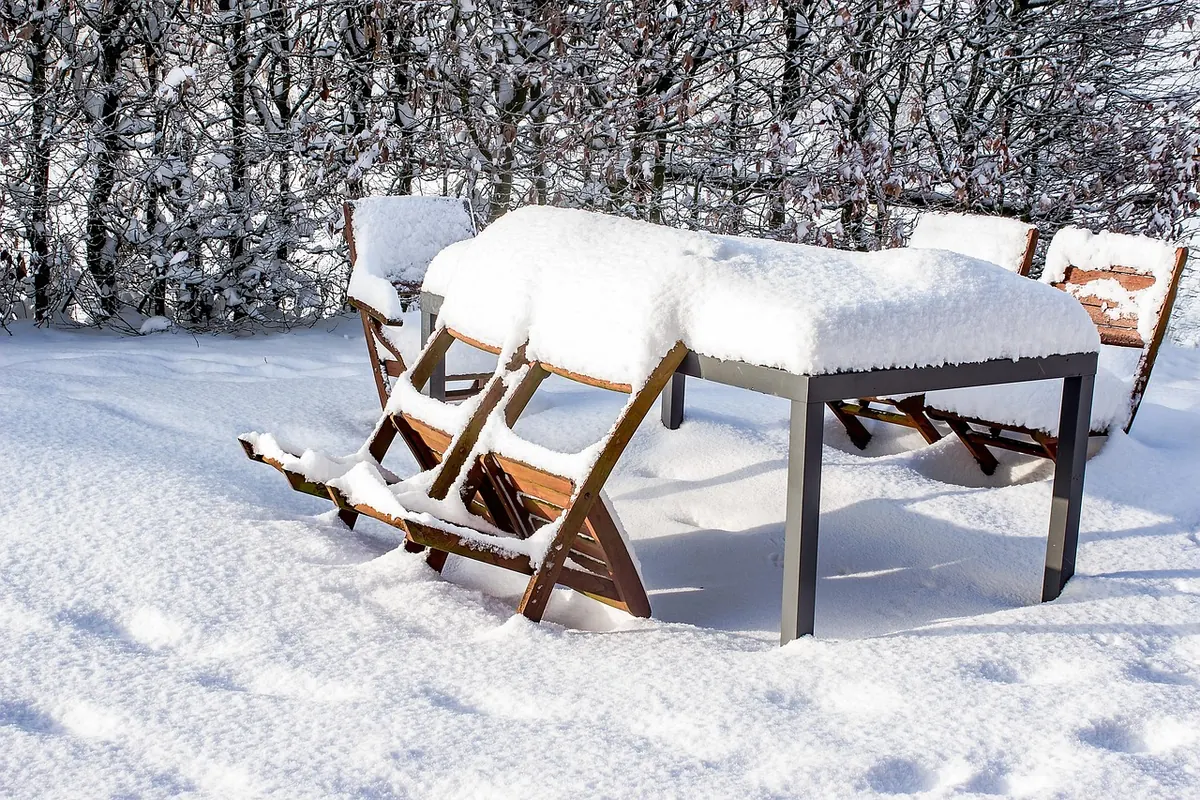
- Garden furniture: Stack chairs, fold tables and store cushions indoors. If you cannot store them, tie them together and anchor them to a sturdy post or wall bracket.
- Parasols and umbrellas: Take them down completely. Even a closed parasol can catch wind and twist its base out of the ground.
- Ornaments and lights: Remove glass lanterns, solar lights, hanging baskets and bird feeders that swing. A hanging basket can smash against a window with surprising force.
- Bins and compost caddies: Store them inside a shed or clip the lids shut. A wheelie bin on its side can roll across a garden and take out a fence panel.
A good rule of thumb is this: if you can push it with one finger, the wind can move it. If you can lift it with one hand, the wind can throw it. Spend twenty minutes doing a full lap of the garden and move anything that fails that test.
Check Trees, Shrubs and Tall Plants
Trees and shrubs are your garden’s natural windbreak, but they also carry the biggest risk. High winds rarely break healthy, well-maintained wood. They break dead branches, weak forks and trees that have been rocked loose in saturated soil. Autumn is the ideal time to inspect before the leaves fall and hide the problem.
- Remove dead wood: Look for hanging branches, cracked bark, fungal brackets and dieback. If a branch is already loose, cut it off cleanly before it becomes a missile.
- Thin dense evergreens: A dense canopy acts like a solid sail. Light thinning lets wind pass through rather than push the whole tree over.
- Stake young trees: Check ties and stakes on trees planted in the last three years. The tie should be firm but not strangling the trunk.
- Secure climbers and wall shrubs: Roses, jasmine and ivy can be torn from walls. Replace broken trellis and add extra vine eyes or tension wire.
- Cut back tall perennials: In exposed gardens, tall grasses and border perennials can be flattened. Leave them for wildlife if you can, but cut back any that block a path or rub against glass.
If you have a large tree near a shed, greenhouse or parking area, and you are unsure about its safety, bring in a qualified arborist. It is far cheaper than replacing a roof. Never try to prune large branches yourself while standing on a ladder in autumn winds.
Secure Fences, Gates and Sheds
Fence panels are the classic casualty of a UK storm. They catch the wind like a sail, then rock until the posts give way. A single loose panel can bang for hours and eventually take the whole run with it.
Fence and gate checks
- Push each post firmly. If it moves, dig out the base and re-set it in fresh concrete or replace it.
- Replace rotten gravel boards and rails before they fail. A rail that snaps in a gust turns the panel into a swinging door.
- Add diagonal braces to gates and fence runs. A simple timber brace can double the strength of an old gate.
- Use galvanised screws rather than nails where possible. Screws hold better under repeated vibration.
- If a panel is already loose, remove it and store it flat. A missing panel is better than a flying one.
Sheds and greenhouses
- Check roof felt and replace lifted edges with adhesive and timber battens.
- Tighten door hinges and add a second latch or bolt. A shed door that blows open can tear off its frame.
- Secure greenhouse glazing clips. Replace missing clips and consider horticultural bubble wrap on the inside for insulation, but make sure vents still close properly.
- Move mowers, tools and paint tins off high shelves. If the shed shifts, heavy items become dangerous.
- Anchor the whole structure if it sits in an exposed spot. Ground anchors and straps are inexpensive and easy to fit.
One of the most useful jobs is also the simplest: walk your fence line and push every panel. If it flexes more than a few centimetres, it needs attention now, not during a red weather warning.
Create a Windbreak, Not a Wall
Many gardeners think a solid wall or a tall, dense fence will stop the wind. In practice, a solid barrier creates turbulence. The wind hits it, rises over the top and then crashes down on the other side with extra force. That is why a solid fence can actually make damage worse in the wrong place.
The better answer is a permeable windbreak. This is a barrier that filters the wind rather than blocking it completely. Aim for around 50% permeability. Good options include woven willow hurdles, slatted fencing, a mixed native hedge, or windbreak netting attached to sturdy posts. Place it on the windward side of the garden, and keep it a sensible distance from greenhouses or patio doors so the airflow has room to settle.
Windbreaks work best when they filter wind, not stop it dead. A solid barrier just moves the problem to the next panel.
If you already have a hedge, resist the urge to cut it hard in autumn. Light trimming keeps it dense without exposing the inner branches to wind. If you are planting a new hedge, choose species such as hawthorn, blackthorn, hornbeam or beech, which hold up well in exposed UK gardens.
Greenhouse, Cold Frame and Cloche Protection
Greenhouses are fragile in high winds because they combine light weight with large glass or polycarbonate panels. Check every clip, bolt and vent. Replace cracked panes before they shatter completely. If a vent is loose, tie it shut with a bungee cord or fit a simple latch. Cold frames and cloches should be moved against a wall or weighted down with bricks. Do not rely on their own weight, especially if they are empty.
Inside the greenhouse, move seed trays and pots off benches if the structure is old. A falling pot can break more glass than the wind itself. If you have a valuable collection of plants, consider moving the most vulnerable into a shed or conservatory for the worst of the winter.
Water, Drainage and Saturated Soil
Wind and water are a dangerous combination. A tree in dry soil can bend and recover. A tree in waterlogged soil can be uprooted because the roots have nothing to grip. Before winter, clear gutters, downpipes and drains. Check that patio drainage runs away from the house. Move pots onto feet or bricks so they do not sit in a puddle. If your soil is heavy clay, add organic matter and avoid walking on it when wet, as compaction makes drainage worse.
Make a Storm Plan and Emergency Kit
A little preparation means you will not be searching for a torch in the dark. Keep a small storm kit in a dry place: a torch with spare batteries, work gloves, secateurs, a tarpaulin, rope or bungee cords, and a first-aid kit. Charge your phone before a forecast storm. Know how to turn off the electricity supply to your shed or greenhouse. If you have a trampoline, either dismantle it or anchor it properly—never assume it is too heavy to move.
- Save the number of a local tree surgeon and a reliable fence repairer.
- Take photos of your garden and shed for insurance before any damage occurs.
- Move your car away from large trees and old fences.
- Never go outside during a red warning to rescue a bin, a cover or a plant. It can wait.
After the Gale: A Quick Damage Check
Once the wind has dropped and it is safe to go out, do a slow circuit of the garden. Look up before you look down. Check for hanging branches, cracked glass, loose fence panels and shifted shed roofs. Do not stand under damaged trees or touch fallen power lines. Photograph any damage for insurance, then make temporary repairs before the next storm. Clear debris from drains and paths, and check that pots and furniture have not become traps for water.
Final Checklist
- Move or secure lightweight patio items, pots, furniture and bins.
- Inspect trees and shrubs; remove dead wood and check stakes and ties.
- Reinforce fences, gates, sheds and greenhouses.
- Install or repair a permeable windbreak on the windward side.
- Secure greenhouse glazing, vents and doors.
- Clear gutters, drains and waterlogged areas.
- Prepare a storm kit and an emergency plan.
- After the storm, check for damage safely and repair before the next gale.
An hour or two of calm-weather preparation is worth far more than a frantic hour during a storm. Start at the patio, work towards the fence line, and treat every loose object as a potential projectile. Your garden may still look battered after a winter gale, but with a little planning, the expensive and dangerous damage is far less likely.
Photo: Myriams-Fotos / Pixabay


You Might Also Like
From frosty January mornings to warm, thundery August afternoons, this month-by-month guide explains typical UK weather, regional quirks and how to plan ahead.
Warmer air holds more moisture, and UK rainfall is increasingly arriving in heavier bursts. Here is what the science says about storm rainfall, flood risk and attribution studies.